

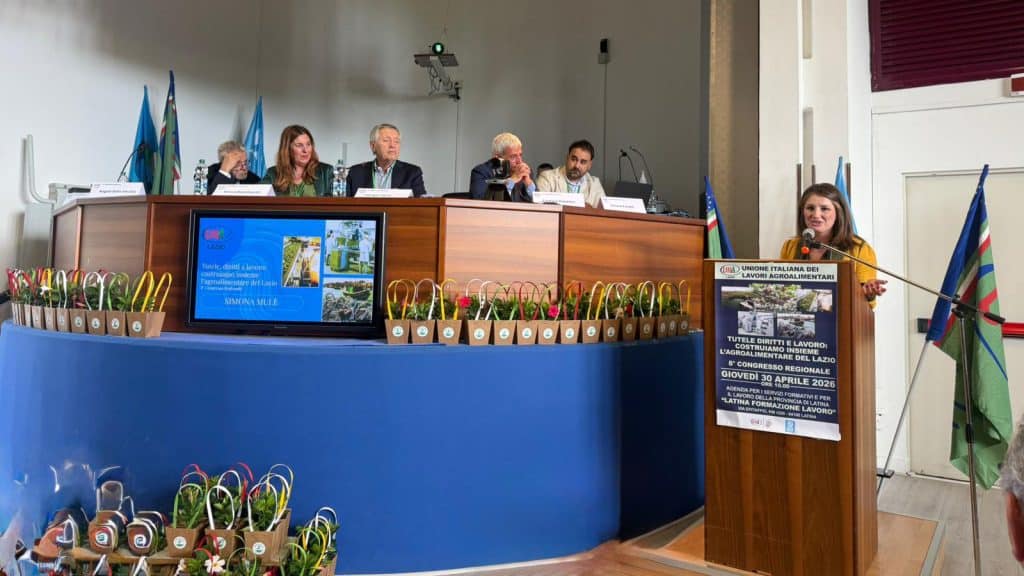
The 8th UILA UIL Regional Congress of Lazio took place in Latina, at “Latina Formazione Lavoro”, an important moment of exchange dedicated to the future of the agri-food sector, with the title “Protection, rights and work: let’s build together the agri-food sector of Lazio”.
An event that brought together institutions, trade union organizations, employers’ associations and local stakeholders, with the aim of reflecting on the challenges and opportunities of a strategic sector not only from an economic perspective, but also from a social, cultural and identity perspective.
Simona Mulè, Coordinator of the ANCI Lazio Women’s Council, intervened on behalf of ANCI Lazio, bringing greetings from President Daniele Sinibaldi and General Secretary Luca Masi, emphasizing the value of an extensive and shared dialogue.
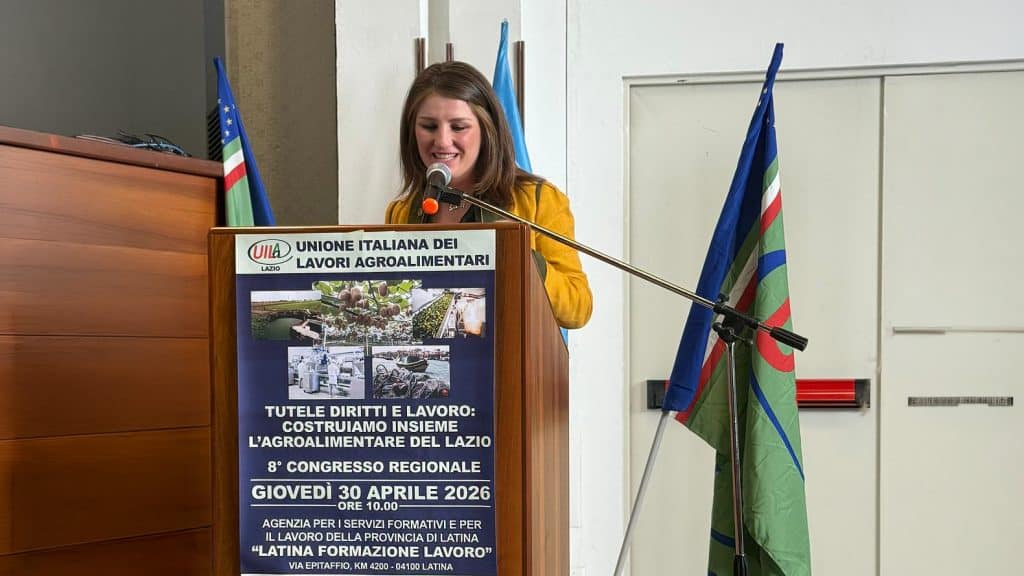
“Building together the agri-food sector of Lazio – he emphasized – means bringing together institutions, trade unions, businesses and local communities, in the awareness that development cannot be separated from the dignity of work, safety, legality and sustainability.”.
In his speech, the central role of the municipalities was reiterated, which are the first institutional presences on the territory and the direct interlocutors of the needs of citizens, agricultural enterprises and workers. For this very reason, ANCI Lazio has invested over the years in concrete projects capable of guiding the territories in processes of social innovation, inclusion and sustainable development.
Among these, the “Origine Comune” project, active since 2015, was mentioned, which has contributed to enhancing territorial identities and local productions through the promotion of De.Co., currently 68 in Lazio, strengthening quality chains and networks between local authorities.
There is also ample space for initiatives funded by the Asylum, Migration and Integration Fund (FAMI), such as the S.O.L.E.I.L. and R.I.P.A.R.O. projects, interregional experiences that promote socio-occupational inclusion and combat exploitation, while strengthening territorial services through dedicated desks and integration pathways. These are complemented by the RILS Lazio, a regional plan for civic-linguistic training.
“Experiences – it was emphasized – that demonstrate how municipalities can be key players in the construction of innovative models of territorial welfare and inclusive development.”.
The Congress also provided an opportunity to reflect on the major challenges facing the agri-food sector: from climate change to rising energy costs, from global competition to technological innovation, and from combating irregular work and forced labor.
In this context, the need for a shared vision and structured dialogue between institutions and the social partners has emerged forcefully, in order to build strong alliances and a governance capable of effectively responding to the needs of the territories.
ANCI Lazio reiterated its commitment to supporting municipalities in participating in national and European opportunities, in building networks between the public and private sectors, and in promoting development models based on environmental sustainability and the centrality of the person.
The Lazio agri-food sector can grow even further, but it must do so without leaving anyone behind, by combining economic development, social justice and the quality of life.