

After Viterbo, the process promoted by the Lazio Region and animated by ANCI Lazio continues to build the strategies for the future programming. Righini: «We want the mayors and the territories to indicate us the best solutions.».
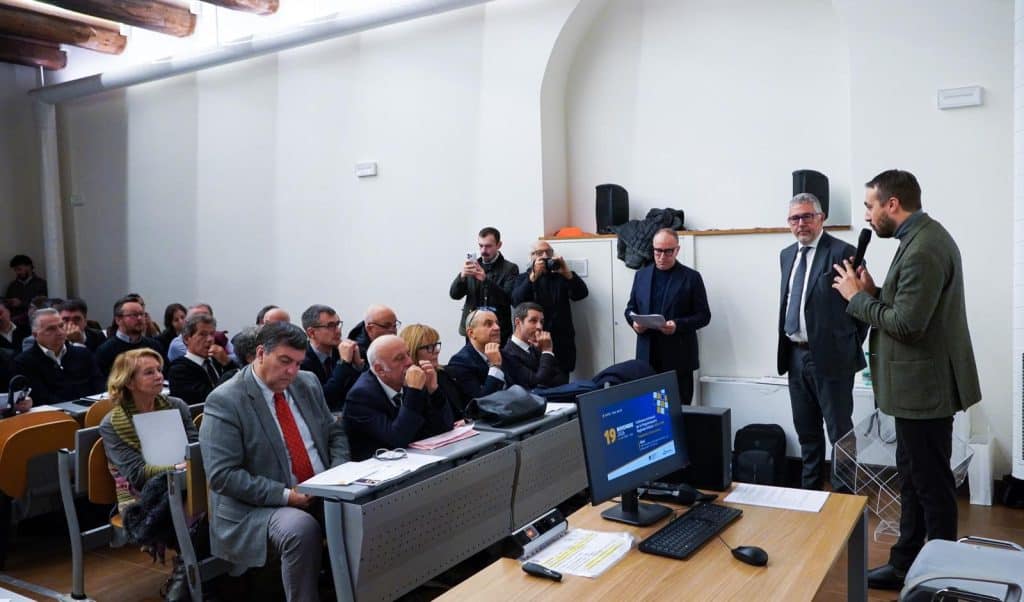
The second meeting of the series of events organized by the University of Rieti Sabina Universitas took place this morning, November 19, at Palazzo Aluffi. Regional Conferences for the Unified Regional Programming 2028-2034, The roadmap promoted by the Lazio Region and animated by ANCI Lazio to involve municipal administrations, institutions, trade associations, and economic and social entities in defining the development priorities for the coming years.
After the inaugural meeting in Viterbo, the discussion journeyed to Rieti, focusing on the needs of a territory characterized by the presence of numerous small municipalities and rural areas, with significant potential related to agriculture, the environmental heritage, sustainable tourism, and local products. This is a reality that faces significant challenges, starting with depopulation, the strengthening of proximity services, and the improvement of infrastructure.
The meeting was attended by Daniele Sinibaldi, President of ANCI Lazio and Mayor of Rieti, Luca Masi, General Secretary of ANCI Lazio, Giancarlo Righini, Regional Councillor for Budget, Economic Programming and Agriculture, Manuela Rinaldi, Regional Councilor for Public Works and Infrastructure, Paolo Alfarone, Regional Director of Economic Programming, European Funds and Natural Heritage of the Region of Lazio, e Michele Nicolai, Regional Councilor of Lazio. Also present were numerous mayors, local administrators and representatives of trade associations, mountain communities, and the economic and social sectors of the territory.
Righini: the municipalities at the heart of the new programming
During his speech, Councilor Giancarlo Righini reiterated the Lazio Region’s commitment to strengthen the role of municipalities in the development policy process, emphasizing that the outcomes of the territorial conferences must translate into concrete guidelines for the 2028-2034 programming period.
The Councilor praised The important territorial coordination work carried out by ANCI Lazio, Recognizing the fundamental role of the Association in involving local administrators. He also ensured that the proposals emerged during the meetings, if they are consistent with the objectives of the future programming, will be taken up in the process leading to the final event scheduled in Rome.
Particular attention has been paid to combating depopulation and supporting the interior areas, recalling the principle of the right to remain in their own territories. Righini highlighted the opportunities offered by agriculture, slow and rural tourism, food and wine tourism, and the valorization of local products to strengthen the economy and create new prospects for development.
Another significant step concerned the resources allocated to local authorities, referring to the Regional Cohesion Fund and the instruments for supporting investment by small municipalities. These are fundamental resources for addressing the daily needs of communities, from road safety to the maintenance of school buildings and the improvement of services.
Righini finally called on the administrators to Overcoming the boundaries of individual municipalities, By promoting shared territorial strategies and interventions capable of networking resources and potential, future programming must support projects that can generate benefits for more communities and contribute to reducing territorial imbalances.
From data analysis to proposals for the territory
As already happened in Viterbo, the event in Rieti was also accompanied by a thorough preliminary work of territorial analysis, carried out through studies of the OpenEconomics, They have provided data and indicators on the economic, social, environmental and infrastructure characteristics of the province. This is a fundamental body of knowledge for identifying priorities and building strategies that are aligned with the real needs of local communities.
The second part of the morning was dedicated to participatory work through the Cubo method developed by Italiacamp, with the present members divided into groups tasked with discussing the six strategic dimensions of future programming: competitiveness and innovation, green transition and energy, infrastructure and mobility, work, skills and inclusion, territories and cohesion, and administrative capacity and governance.
The comparison has allowed for the collection of observations, needs and proposals, while also highlighting positive experiences and identifying possible shared solutions to address the main challenges facing the territory.
A shared path to build the future of Lazio
With the stop in Rieti, the cycle of territorial conferences continues, involving the different areas of Lazio, until the final event in Rome, where the results of the work carried out will be collected and presented.
ANCI Lazio confirms its role as a link between the Region, the Municipalities and local entities, By contributing to the construction of a participatory process in which local administrations are key players in strategic choices and the definition of investment priorities.
The goal is to transform the needs and proposals expressed by the territories into concrete guidelines for the 2028-2034 Regional Unified Programming, promoting a balanced, sustainable development capable of offering new opportunities even to smaller communities and the interior areas of Lazio.