

Marina Battisti, Vice President of ANCI Lazio, intervened at the international conference dedicated to the new opportunities of social entrepreneurship, emphasizing the strategic role of municipalities in promoting local development, training and employment inclusion.
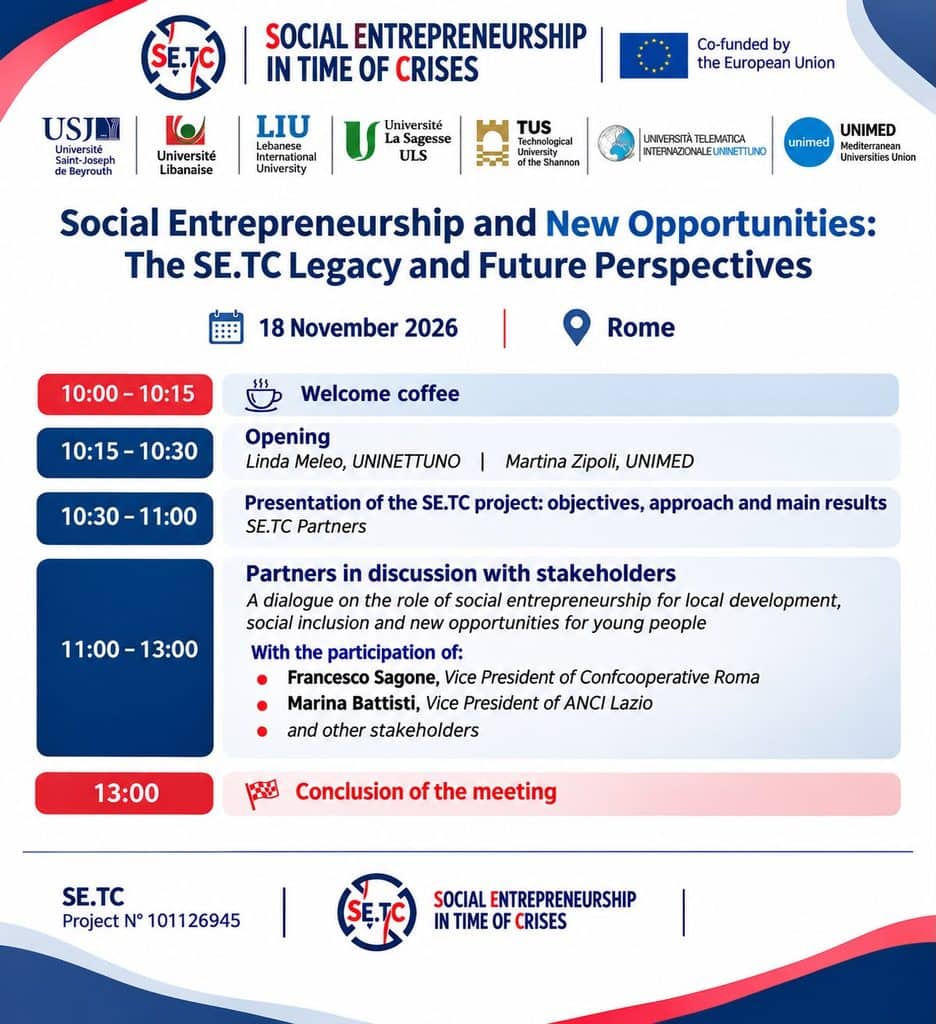
The meeting took place today, November 18, at the Sala Laudato Si’ at the Campidoglio in Rome. “Social Entrepreneurship and New Opportunities: The SE.TC Legacy and Future Perspectives”, dedicated to the results and perspectives of the European project SE.TC – Social Entrepreneurship in Time of Crises, co-funded by the European Union within the Erasmus+ program.
The initiative brought together representatives of the university world, institutions, third sector organizations and international stakeholders to deepen the contribution of social entrepreneurship to the growth of territories, the creation of new employment opportunities and the promotion of development models capable of responding to the needs of communities, with particular attention to young generations and people in vulnerable situations.
ANCI Lazio participated in the meeting with Vice President Marina Battisti, He took part in the round table dedicated to the dialogue between the project partners and the stakeholders, together with Francesco Sagone, Vice President of Confcooperative Roma, and the other representatives of the organizations involved.
In his speech, Battisti recalled the importance of the role played by municipal administrations in identifying the needs of communities and in creating the conditions for innovative ideas to be transformed into entrepreneurial initiatives capable of generating social value and new job opportunities. Municipalities are indeed the first point of reference for citizens and families and can play a crucial role in linking schools, social services, employment centers, universities, and third-sector organizations.
Particular attention has been paid to the differences between the territories, from urban peripheries to small municipalities and the interior areas, where difficulties in accessing services, training and employment opportunities require responses built around the needs of the local communities. In this context, social enterprise can represent a concrete tool for enhancing territorial resources, promoting the employment integration of the most vulnerable people and developing innovative services.
During the discussion, some significant experiences from Lazio were also highlighted, such as the cooperative Agricoltura Capodarco in Grottaferrata, which integrates agricultural production and employment inclusion, and the Locanda dei Girasoli in Rome, an example of how a restaurant business can offer training programs and professional opportunities to young people with cognitive disabilities.
A central element of the ANCI Lazio intervention was the connection between training, social innovation, and the concrete needs of the territories. Collaboration between local administrations, universities, students and cooperatives can indeed foster the experimentation of new initiatives, starting from identifying a real need and accompanying the development of sustainable solutions over time.
In this perspective, ANCI Lazio’s commitment to the project also fits in. INCLUDO+, The project, which sees the Centro Studi – Opera Don Calabria in the role of lead partner and involves eight partners, aims to combat the digital divide and to promote social and work inclusion through training, mentoring and professional guidance programs.
The proposal involves the involvement of 1,302 beneficiaries in ten Italian regions, including Lazio, with 93 training courses dedicated to the development of digital, personal, and relational skills. ANCI Lazio would contribute to the initiative by liaising with municipalities, social services, and local entities to facilitate access to training opportunities for those who are most difficult to reach.
The meeting at the Campidoglio therefore represented an important opportunity to consolidate the dialogue between institutions, academia and the Third Sector, while also highlighting the results of the SE.TC project and identifying new perspectives for collaboration.
For ANCI Lazio, the promotion of social entrepreneurship and skills is a fundamental component of territorial development policies, in the belief that innovation, inclusion and collaboration between public and private actors can contribute to building more cohesive communities and offering concrete opportunities for autonomy and work.