

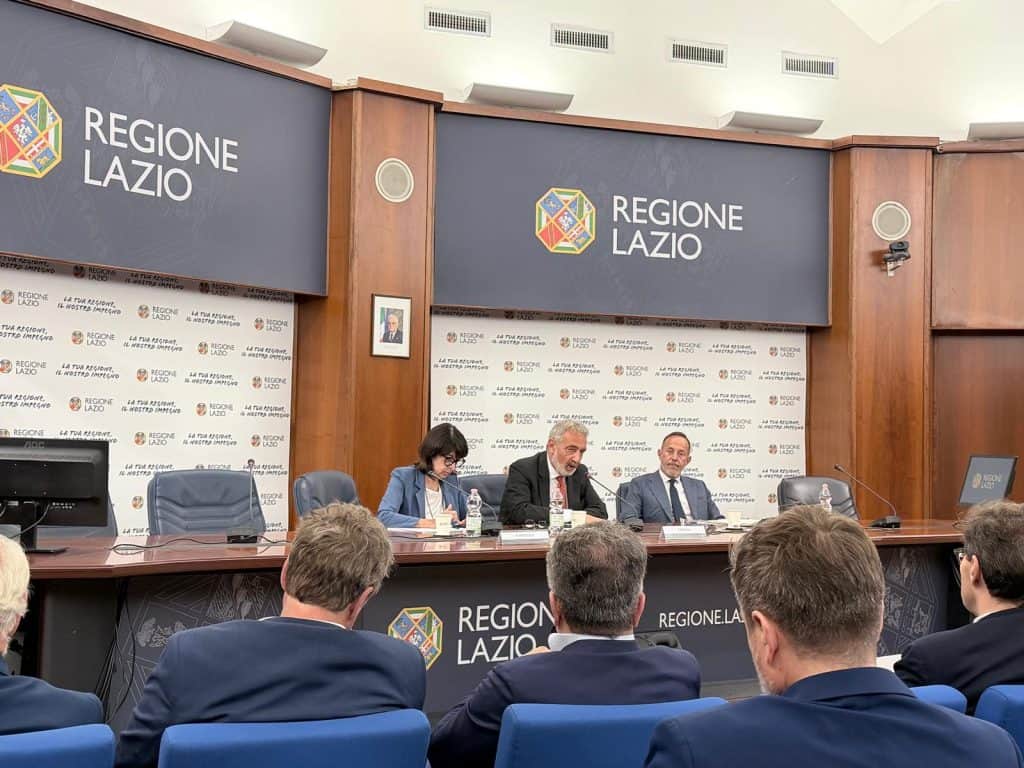
A system-wide reform for the industrial revival of Lazio. This is the horizon of the regional bill that redesigns the Lazio Industrial Consortium, configuring it as a regional public economic body and expanding its territorial perimeter, corporate base and functions. The objective is to promote the region's productive development and the attraction of investments, equipping the body with more incisive tools in terms of planning and management. ANCI Lazio is following the measure also in its capacity as a member of the Consortium.
Cornerstone of the reform, illustrated by the Vice-President and Councillor for Economic Development Roberta Angelilli, is the entry of the Lazio Region into the Consortium with a 51 percent stake and the resulting majority role. A choice aimed at strengthening the management of the entity and ensuring its financial stability, overcoming the limits of the previous approach in terms of planning and investment.
The entrance of the Region is accompanied by a new governance structure, characterised by greater efficiency, administrative simplification, separation between policy-making and management, and the strengthening of managerialism. The Consortium will retain its managerial autonomy while simultaneously taking on a more integrated role with regional strategies for industrial development. At the organisational level, the reform provides for an Assembly with functions concentrated on policy and control acts, an eleven-member Supervisory Board, and a five-member Management Board with operational responsibilities. The president of the Consortium will be appointed by the president of the Lazio Region, while the vice-presidency will be nominated by the Metropolitan City of Rome Capital.
On the territorial front, the reform expands membership to Roma Capitale and numerous municipalities, with the return of strategic entities that were not previously members: Colleferro, an industrial and logistics hub; Civita Castellana, a ceramics district; and Civitavecchia. The permanent inclusion of these settlements completes the Consortium's structure on a regional scale. «With the entry of Roma Capitale, a true single industrial Consortium is taking shape, capable of representing the entire regional territory,» observed Righini, recalling the creation of the body from the merger of numerous industrial consortions and the objective of centralized, organized management shared with trade associations, Chambers of Commerce and local authorities.
Among the new features are the setup of the Consortium as a single desk for the areas included in the Simplified Logistics Zone (ZLS), in complementarity with the related provision, and the assignment of functions in areas such as logistics, services, commerce and crafts, acting as an activator of services for businesses and regions.
In terms of resources, the councillor for budget Giancarlo Righini He outlined the financial provisions supporting the measure and an approach geared towards investing without resorting to new debt. Among the tools planned is a revolving fund designed to generate resources for the acquisition of industrial areas to be transferred to the Consortium and to strengthen its production capacity, whilst the overall public finance framework is accompanied by a positive administrative surplus of 321 million euros. «Along with the recent establishment of the Simplified Logistics Zone and the budget allocations,» Righini emphasised, "the measure will make a significant contribution to strengthening Lazio's industrial capacity." Also on the financial front, Righini announced an initial investment of approximately 8 million euros for the reuse of water for industrial purposes, largely earmarked for the industrial area and with potential application in agriculture as well.
The President of the Region, Francesco Rocca, has positioned the reform within the objective of making the Consortium an instrument of an effective regional dimension, in coordination with an industrial plan defined together with businesses and trade associations. The process aims for rapid approval, while maintaining dialogue with productive sectors, the Chambers of Commerce and the Regional Council, with the stated objective of approving the law prior to joint examination with the budget amendment and the 2025 financial statements.