

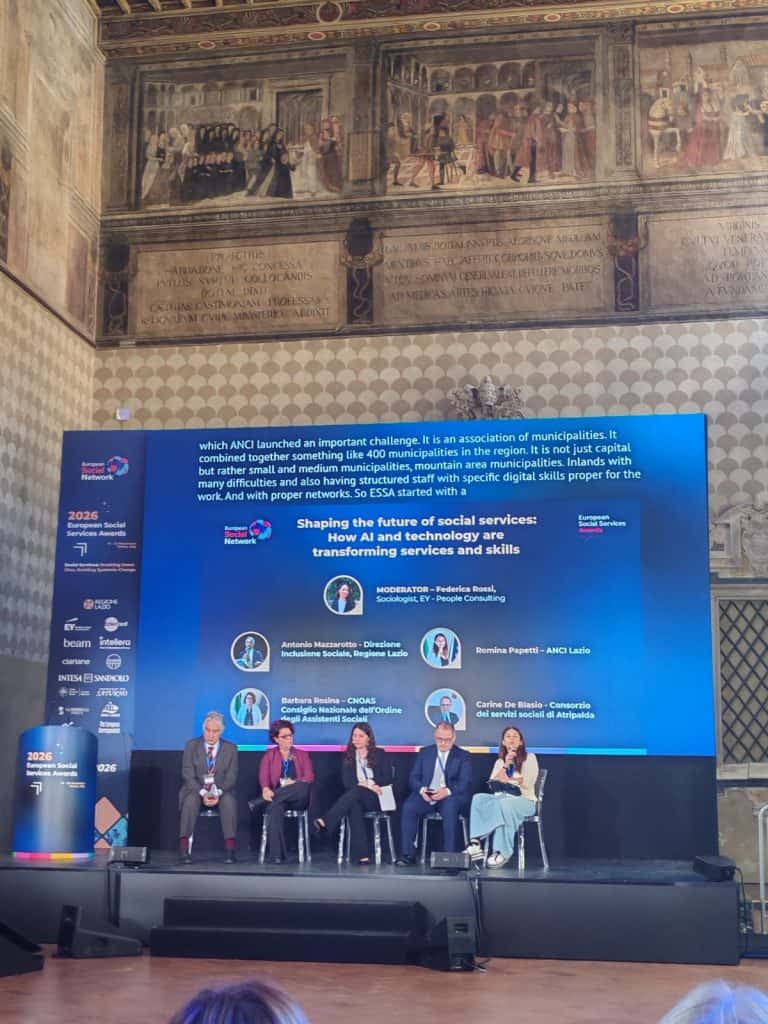
Romina Papetti, member of the Technical and Scientific Committee of ANCI Lazio, among the speakers at the European conference dedicated to the transformation of social services through artificial intelligence and new technologies.
ANCI Lazio participated in the European Social Services Awards 2026, Held on November 19 and 20 in Rome, in the prestigious setting of the Sistine Galleries. The initiative, promoted by the European Social Network (ESN) in collaboration with the Lazio Region, represented an important international forum for discussion on the future of welfare, the integration of services, and the opportunities offered by technological innovation to improve the quality of social interventions.
The 2026 edition, dedicated to the theme “Social Services: Breaking Down Silos, Building Systemic Change”, In the debate, he placed the need to overcome the fragmentation of services and strengthen collaboration between institutions, administrations and professionals at the center, promoting welfare models that are increasingly integrated, accessible and capable of responding to the needs of communities.
Among the moments of in-depth discussion, the conference “Shaping the future of social services: How AI and technology are transforming services and skills”, dedicated to the role of artificial intelligence and digital technologies in transforming social services and evolving professional skills.
The works were introduced by Ornella Guglielmino, Director of the Regional Directorate for Social Inclusion of the Lazio Region. The session, moderated by Federica Rossini, a sociologist at EY – People Consulting, saw the interventions of Antonio Mazzarotto, Director of the Social Inclusion Area of the Lazio Region, Romina Papetti, member of the Technical and Scientific Committee of ANCI Lazio, Barbara Rosina, of the National Council of the Order of Social Workers (CNOAS), and Carine De Blasio, of the Consortium of Social Services of Atripalda.
Romina Papetti's participation has allowed the point of view of ANCI Lazio and the municipal administrations to be brought into the European debate., They play a central role in the programming and implementation of social policies and represent the main point of reference for citizens in accessing territorial services.
The debate deepened the opportunities offered by artificial intelligence to improve the organization of services, simplify administrative processes, enhance the available information, and strengthen the ability to identify timely and appropriate responses to people’s needs. This is a path of innovation that requires not only the introduction of new technologies, but also investments in training, skills upgrading, and support for social workers.
Particular attention was paid to the need for Combining digital transformation and the centrality of the person, In order for technological tools to support the work of professionals without replacing the value of human interaction, listening, and proximity. Artificial intelligence can represent an important resource for territorial well-being, provided that its use is oriented towards protecting rights, protecting personal data, and ensuring fair and inclusive services.
In this scenario, municipalities are called upon to play a decisive role, not only as providers of services, but also as protagonists of an organizational and cultural change that requires collaboration between the different institutional levels, the sharing of experiences, and the development of new skills.
The presence of ANCI Lazio at the European Social Services Awards 2026 confirms the Association’s focus on the processes of innovation in local welfare and the commitment to accompany municipal administrations in the challenges of digital transformation, fostering dialogue between institutions, professionals, and the social system.
The goal is to contribute to the construction of increasingly modern, integrated and accessible social services, in which technological innovation becomes a concrete tool to improve the quality of interventions, strengthen the capacity of response of the territories and place people and communities increasingly at the center.