


On December 2nd at Palazzo Savelli, a training day dedicated to “Powers and limits of the management body”. The collaboration between ANCI Lazio and Gazzetta Amministrativa continues to strengthen the skills of the staff of local authorities.
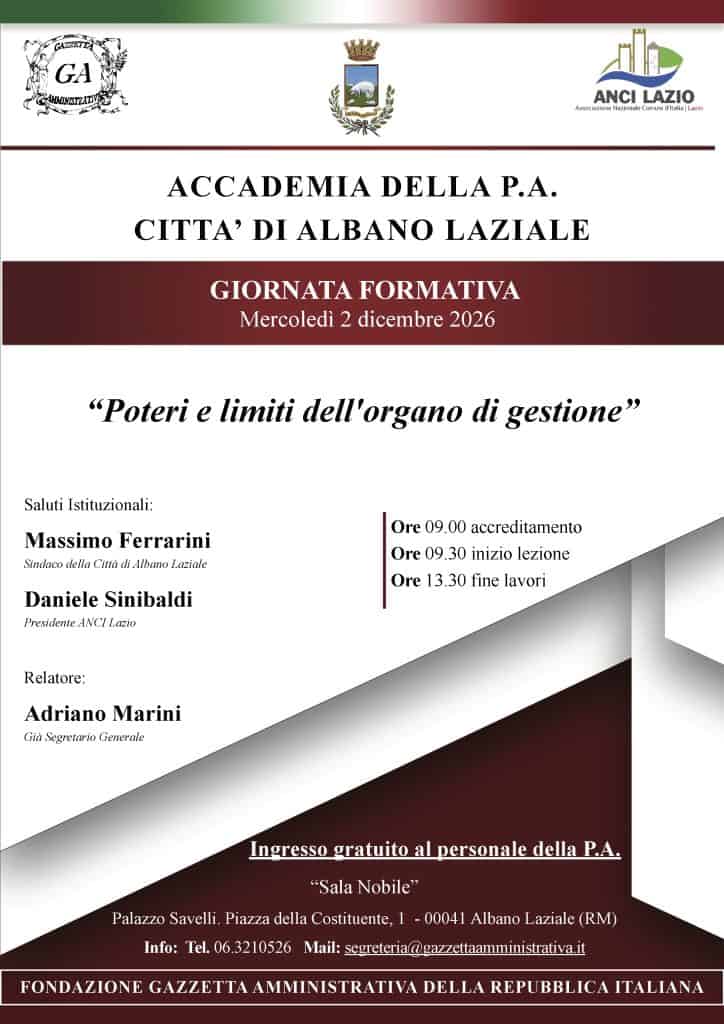
It will begin Wednesday, December 2, 2026, in Albano Laziale, the new training course aimed at public administration staff, Promoted as part of the activities of the Academy of the P.A. of the Gazzetta Amministrativa della Repubblica Italiana, with the involvement of ANCI Lazio.
The first event, held in the Sala Nobile of Palazzo Savelli, will be dedicated to the theme “Powers and limits of the management body”, This is an issue of particular importance for the functioning of local authorities, the proper distribution of administrative responsibilities and the exercise of management functions.
The initiative is part of the already established collaboration process between ANCI Lazio and Gazzetta Amministrativa, These have also organized meetings and in-depth lectures aimed at administrators, managers, officials and public employees in recent months. This training activity continues with the aim of offering local authorities tools for updating and opportunities for discussion on the main legal, administrative and organizational issues that affect the daily work of municipalities.
The day of December 2 will begin at 9:00 with the accreditation of the participants, followed at 9:30 by the institutional greetings of Massimo Ferrarini, Mayor of the City of Albano Laziale, and Daniele Sinibaldi, President of ANCI Lazio and Mayor of Rieti.
The lesson will be taught by Adriano Marini, former Secretary General, The meeting will delve into the topic of the powers and limits of the management body, with particular attention to the framework of competences and responsibilities within the administrative activities of local authorities. The meeting will conclude at 13:30.
The topic addressed represents an important opportunity for updating for the staff of local authorities, who are called upon to operate in an increasingly complex regulatory and organizational context, where clarity of responsibilities, compliance with procedures and the proper assumption of responsibilities constitute essential elements for ensuring the effectiveness, transparency and proper functioning of administrative action.