

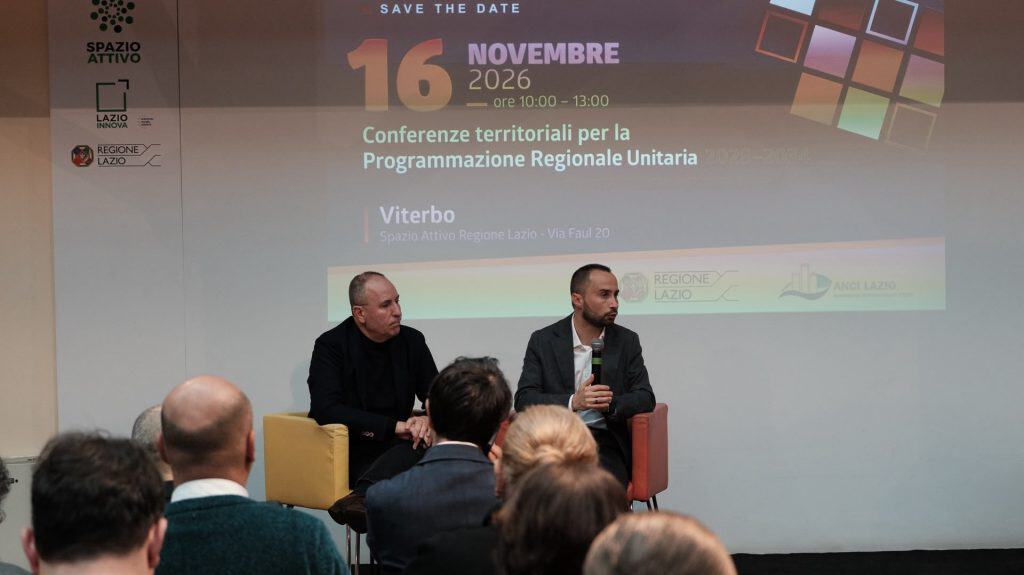
The first meeting of the territorial conferences promoted by the Lazio Region and animated by ANCI Lazio. A process of listening and participation, supported by an in-depth analysis of the territory, to identify development priorities and build the strategies for the future regional programming.
The first meeting of the project took place on November 16th at the Active Space of the Lazio Region in Viterbo. Regional Conferences for the Unified Regional Programming 2028-2034, The roadmap promoted by the Lazio Region and animated by ANCI Lazio aims to involve municipal administrations, institutions, representatives of the economic and social world, associations and local entities in defining the development strategies for the coming years.
The province of Viterbo has important economic, environmental and cultural resources, which represent concrete opportunities for the growth and enhancement of the territory. Alongside these potentialities, however, certain criticalities emerge, particularly in the fields of infrastructure, accessibility and services, which require careful planning based on local specificities. The meeting represented the first step in a series of ten territorial conferences that will cover the entire Lazio region, initiating a process of listening and participation aimed at gathering needs, identifying priorities and building shared proposals in view of the new European programming cycle.
The opening of the proceedings was opened by Luca Masi, General Secretary of ANCI Lazio, who introduced the objectives of the initiative and explained the modalities of the day’s proceedings. The institutional greetings were followed by those of Riccardo Varone, Vice President of ANCI Lazio and Mayor of Monterotondo, and the intervention of Matteo Amori, Mayor of Sutri and member of the ANCI Lazio Board of Directors, This brought the perspective of the local administrators, based on direct knowledge of the needs and potential of the territory. The discussion continued with Federico Palla, General Director of ANCI Lazio, and with the technical deepening of Paolo Alfarone, Regional Director of Economic Programming, European Funds and Natural Heritage of the Region of Lazio, which focused on the prospects and instruments of the new programming.
A central contribution came from’Regional Councilor for Budget and Economic Programming, Giancarlo Righini, Righini, who outlined the directions of the new programming, recalled the need to effectively use the available resources to reduce territorial disparities and strengthen the development opportunities of local communities. During his speech, Righini emphasized the importance of the listening and dialogue process initiated with the territorial conferences, recognizing the value of the important preliminary work of analysis and mapping of the territories that accompanies the initiative. An activity that, through the involvement of ANCI Lazio And the technical contribution of the involved parties will allow us to gather the needs of the local administrations and translate them into concrete guidelines for the future regional programming 2028-2034.
Antonella Sberna, Vice-President of the European Parliament, He highlighted that the new programming cycle represents a great opportunity for municipalities, emphasizing the importance of starting now a process of preparation and exchange, so that local administrations can organize themselves in time, develop shared projects and arrive prepared to face the challenges and opportunities of the future European programming.
An in-depth analysis of the territorial situation
A central element of the initiative is represented by the important territorial analysis work carried out through the study prepared by OpenEconomics, The Viterbo Observatory, which has made available data and indicators on the economic, social, environmental and infrastructure characteristics of the province of Viterbo. This knowledge base allows for a more precise identification of the strengths, criticalities and growth opportunities of the territory, providing a concrete basis for comparison between institutions and local realities.
The analysis reveals a province characterized by a strong agricultural vocation, with products representing 22.2% of exports, compared to 1.8% in Lazio without Rome. At the same time, the logistics sector accounts for 4.8% of employees, approximately half of the regional average of 9.5%. Tourism also shows potential that still needs to be developed: with 185 beds per thousand inhabitants, almost double the regional average of 93, annual attendance per bed stands at 27, compared to the 42 in the comparison data.
On the environmental front, the primacy in photovoltaic production, with 5.14 kW per inhabitant, coexists with critical issues related to hydrogeological risk and accessibility of services. 4.5% of residents are exposed to the risk of landslides, while 38% of the population lives in remote inland areas away from the main services. These challenges are added to the aging population, the need to strengthen infrastructure and connections, and the opportunity to further enhance the cultural and tourism heritage, also through strategies of destagionalization. A territory that nevertheless shows signs of dynamism, as demonstrated by the employment rate of 62.4% and the 17% share of PNRR projects managed directly by the municipalities.
Participatory work and the six strategic dimensions
The second part of the morning was dedicated to direct interaction between the participants, divided into working groups through the Cubo method developed by Italiacamp. A participatory approach that has allowed for the deepening of the six strategic dimensions of future programming: competitiveness and innovation, green transition and energy, infrastructure and mobility, work, skills and inclusion, territories and cohesion, administrative capacity and governance.
Based on the data emerging from the territorial analysis, administrators, representatives of institutions, associations and economic and social actors shared experiences, needs and proposals, following an articulated path around three fundamental questions: What to keep, what to discontinue and what to propose again. A method designed to valorize the experiences that have produced results, identify interventions that need to be reconsidered, and build new shared solutions capable of responding to economic and social transformations.
The reflections and proposals developed by the groups were collected in the six faces of the cube, giving shape to a concrete representation of the territory’s contribution to future programming. A work that puts active participation at the center and recognizes local administrations, associations, and the various territorial realities a fundamental role in the construction of public policies.
The Viterbo event thus marks the start of a process aimed at bringing the voices of the territories into the definition of the strategic choices of the Lazio Region for the period 2028-2034. ANCI Lazio plays a role of coordination and animation in this process., By promoting dialogue between institutions and local communities and helping to build programming that is increasingly tailored to the specificities and needs of the territories.
The goal is to transform the discussion initiated at the conferences into a shared repository of knowledge, priorities and proposals, so that future programming can support a balanced, inclusive and sustainable development that can harness the potential of every region in Lazio.