

Sinibaldi: “A recognition that consolidates the role of the Association alongside the territories”. Righini: “From assisting a structured system of support for local authorities”. Leodori: “A positive path to be strengthened in the coming years”
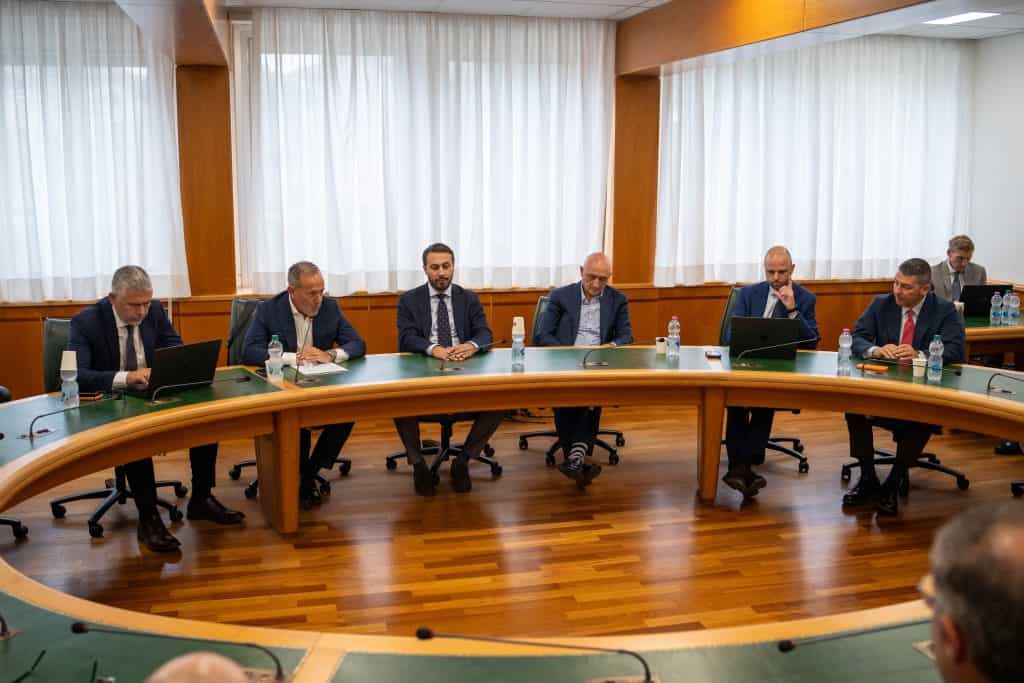
Rome, October 7, 2026 – To return the work done, to systematize the results achieved and, above all, to build on this experience a new phase of collaboration between ANCI Lazio, the Lazio Region and the local autonomies. This was the guiding thread of the meeting dedicated to’Lazio Development Observatory, promoted by ANCI Lazio at the Sala Latini of the Lazio Regional Council.
The appointment represented the moment of returning to the project, the activities carried out and the insights gained through the dialogue with the territories, but also the opportunity to look to the continuation and strengthening of an experience that in recent years has helped to grow the capacity for collaboration between the Region and the local authorities.
A path that today takes on an even more significant meaning in light of the recent law approved by the Regional Council, which recognizes and strengthens the role of ANCI Lazio in providing technical assistance to small municipalities. This thus consolidates, at the institutional level, a model developed through the work of the Observatory: an ANCI that, alongside its role as a representative body, increasingly stably assists municipalities in programming, planning, and accessing development opportunities.
An evolution that increases the role of the Association in the regional system of autonomies and strengthens an experience that can assume increasing importance also on the national scene, making Lazio a laboratory for structured collaboration between the Region, ANCI and municipal administrations.
The president of ANCI Lazio opened the discussion., Daniele Sinibaldi, That indicated in the Observatory’s return not a point of arrival, but the start of a phase of renewal and strengthening.
The new regulatory framework, Sinibaldi emphasized, provides continuity and recognition to work built over time and allows ANCI Lazio to make its own action even more structured alongside the administrations. This is a need that is particularly evident in small municipalities, which must face increasing administrative complexity while often having limited staffing and limited resources.
It is precisely in this area that the Association can play an increasingly significant role: providing expertise, tools, and support capabilities, while supporting mayors in the implementation of interventions and the provision of services to citizens. This role is particularly important in a diverse region like Lazio, characterized by profoundly different territorial and administrative realities and a significant presence of small-sized municipalities.
For Sinibaldi, the recognition contained in the law also marks a growth in institutional awareness regarding the needs of the system of local autonomies and the role that ANCI Lazio can play as a link between the needs of the territories and regional planning. The president therefore thanked the regional councillor Giancarlo Righini for the support provided for the process that led to the approval of the law.
Exactly Giancarlo Righini, Regional Minister for Budget, Economic Programming, Agriculture and Food Sovereignty, Hunting and Fishing, Parks and Forests, emphasized the value of the experience achieved through the Observatory and the need to further consolidate its instruments.
The proposed approach is to evolve the OSL from a support tool into a structured system of support for local authorities, capable of responding in a differentiated manner to the characteristics and needs of municipalities. This is a particularly important step for smaller municipalities and those located in the interior areas, where the limited availability of staff is accompanied by an increasing volume of activities, procedures and opportunities to manage.
The project thus enters a phase in which the support can be further structured based on the different territorial needs, integrating into a broader strategy of rebalancing and development. Mobility, housing policies, investments, services and administrative capacity become parts of a single vision, in which support for municipalities contributes to creating more balanced growth conditions across the different areas of Lazio.
Righini also called for the continuation of the Observatory and the strengthening of its governance, also through the planned establishment of a joint committee, in the subsequent phase following the approval of the budget law. The goal is to provide greater stability to the collaboration between the Region and the system of autonomous communities, and to build instruments capable of accompanying programming over time, while safeguarding the resources necessary for the regular policies of the territories.
To complete the institutional framework, Daniele Leodori, Regional Councilor of Lazio, he recalled the positive and constructive nature of the path taken by the Observatory. The availability of new funding opportunities, he highlighted, makes it even more important to have organized tools for accompaniment and to capitalize on the wealth of skills developed by the project. A function destined to assume particular importance in the coming years, also in relation to European funds and the ability of territories to increase their own competitiveness.
The return also allowed the work carried out by the Observatory’s structure and the technical-scientific committee to be brought back to the center, translating the listening to the territories into indications on the main areas to focus future programming on.
The director of ANCI Lazio, Federico Palla, He emphasized in particular the importance of the measurable nature of interventions and results, an essential element for consolidating the new phase of development and for verifying the effectiveness of the actions implemented in practice. In his speech, he also expressed his gratitude to the staff of the Observatory and the members of the CTS for the work carried out during the project.
The comparison with the territories was also represented by the interventions of the provincial project managers and members of the CTS. Carlo Fiacchi, Pasquale Ranucci and Mario Tersigni, These have returned some of the main needs that emerged in their respective work areas.
Fiacchi drew attention to the relationship between water resources, infrastructure, taxation and investment in productive areas, highlighting the need to continue working on the conditions that can support development and competitiveness, with a particular focus on the internal territories.
Ranucci focused his intervention on the development of the Latium coastal strip, a territory characterized by different realities and landscapes but also by common issues, from erosion to sea-level rise, from seasonality to fishing, to the complex governance of maritime property. From here, the indication to foster stable forms of dialogue and coordination between the different involved parties, also through a permanent table dedicated to the management and development of the Latium coast.
Tersigni, on the other hand, has placed the focus on the internal areas, highlighting two major challenges in particular: combating depopulation and preventing seismic and hydrogeological risks. These issues require a long-term perspective and make it essential to plan the use of resources for the coming years from now, so as to build coherent and continuous interventions.
The issue of the inner areas was also addressed by Paolo Alfarone, This report, which draws on the experience gained from the various programming cycles and the work carried out in the seven internal areas of Lazio, highlights the importance of further strengthening the instruments for supporting the implementation of interventions and of drawing on previous experiences in building future programming.
It was therefore necessary to reconstruct the meaning of the path taken by the Observatory. Manuel Magliocchetti, Member of the Board of Directors of ANCI Lazio, who recalled that the initiative launched in recent years was initially a gamble, gradually becoming a project capable of entering into the mechanisms of institutional collaboration and reaching concrete results in the territories. A path that, he emphasized, has also contributed to changing and strengthening ANCI Lazio’s regional positioning.
A concept that was taken up in the conclusions by the Secretary General of ANCI Lazio, Luca Masi, This has not marked the end of the experience, but rather a new starting point. The challenge of the coming years will be to seek an ever-increasing balance in the use of new resources and, at the same time, to strengthen and further qualify the intervention capacity of ANCI Lazio, consolidating the relationship with the institutions and providing the territories with increasingly appropriate tools to meet the new needs.
The result is an Observatory that does not simply photograph the needs of local authorities; it has built over the years the skills, relationships, and tools for intervention. The project’s results showed how different issues – from infrastructure to productive areas, from the coast to the interior, from administrative capacity to European programming – can be brought together within a common vision of regional development.
The new phase of the’Lazio Development Observatory It all starts from this heritage. The recently approved law offers a more solid framework for a model in which ANCI Lazio is increasingly consolidating itself as an institutional infrastructure at the service of the municipalities, capable of linking regional planning with local needs, transferring competencies, assisting the entities, and contributing to the development policy’s construction.
A role that strengthens the relationship with the Lazio Region and increases the Association’s weight in the system of autonomous regions, continuing an experience that, born from the territory, can take on an increasingly significant value even in the national comparison regarding the forms of support and accompaniment for municipalities.