

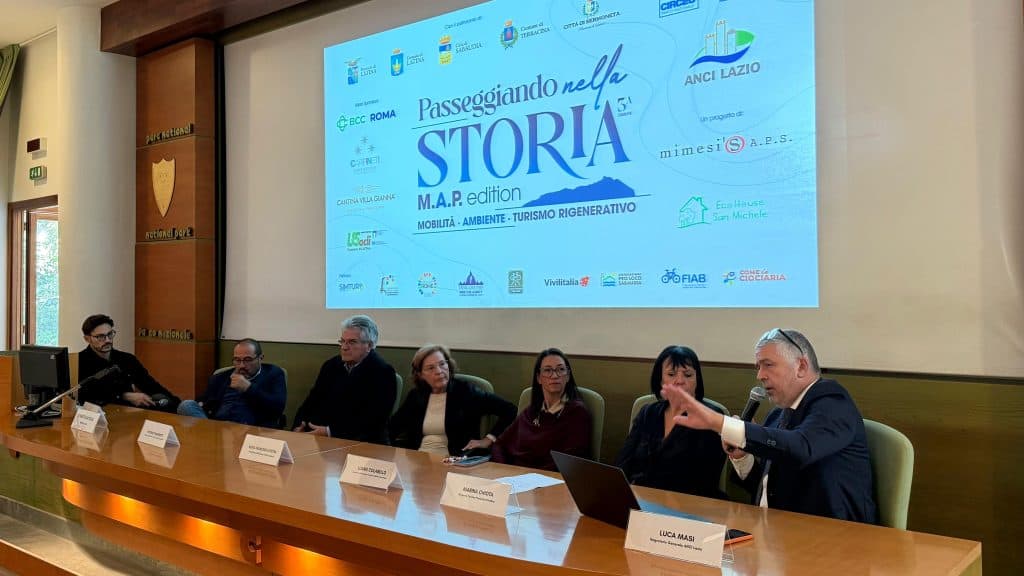
Secretary General Luca Masi attended the inaugural conference of the initiative, recalling the agreement with the Lazio Region for the development of cycling paths and the role of municipalities in the enhancement of territories.
The inaugural conference of the third edition of the festival took place yesterday, Tuesday 10 November, at the Auditorium of the Visitor Center of the Circeo National Park in Sabaudia. “Walking Through History – M.A.P. Edition 2026”, The initiative promoted by Mimesi’s A.p.s. and Eco House San Michele, dedicated to sustainable mobility, environmental protection and regenerative tourism. Representatives of the project participated in the event, representing ANCI Lazio, General Secretary Luca Masi, He intervened to illustrate the Association’s commitment to promoting cycle paths and green infrastructure as tools for the development and enhancement of the regional territory.
The opening of the works was made by institutional greetings from Emanuela Zappone, President of the Circeo National Park, Luca Masi, General Secretary of ANCI Lazio, and Stefano Donati, Director of the Circeo National Park. The day continued with a discussion between representatives of institutions, associations and industry professionals, with the interventions of Sebastiano Venneri, President of Vivilitalia, Isabella Carpineti of Carpineti Experience, Giorgio Sigillò of Trail dei Papi, Mario Salati of Come in Ciociaria, Silvia Francesca Pietra, President of FIAB Roma Ruota Libera, and Paola Sarcina, President of DMO Around Rome. The final intervention was entrusted to Federico Massimo Ceschin, National President of SIMTUR.
In his contribution, Luca Masi recalled the agreement between the Lazio Region and ANCI Lazio for the enhancement of cycling routes, emphasizing the importance of building a regional network capable of connecting cities, villages, natural areas, and places of historical and cultural interest. This path involves ANCI Lazio’s involvement in the working group dedicated to cycling routes, with the goal of fostering coordination between local administrations, enhancing existing projects, and promoting an integrated vision of sustainable mobility.
Particular attention has also been paid to the experience of Padua Cycling Tourism Fair, This initiative, in which ANCI Lazio participated last March together with the Lazio Region, involving associations and organizations committed to the promotion of cycling routes and slow tourism. Among these organizations is Mimesi’s, which is now a key player in organizing “Passeggiando nella Storia”, a testament to the continuity of the collaboration between institutions and territorial entities in creating new opportunities for development.
The Pontine territory, with its natural, landscape and cultural heritage, represents a particularly significant context for experimenting with forms of sustainable tourism capable of combining the protection of the environment with the enhancement of local communities. In this perspective, initiatives such as “Walking Through History” contribute to promoting a deeper understanding of the places, fostering collaboration between municipalities, associations, businesses and tourism operators.
The event will continue until November 15 with a program of activities dedicated to participation and discovering the territory. Today, November 11, the Michelangelo Buonarroti State Art High School in Latina hosts a hackathon aimed at students and dedicated to territorial planning, while on November 14 and 15 there are planned bike tours to rediscover the historical, environmental and landscape heritage of the Pontine Agro.
The initiative is held with the contribution of the Circeo National Park and ANCI Lazio, and with the sponsorship of the Province of Latina and the municipalities of Latina, Sabaudia, Terracina and Sermoneta. It is an opportunity to strengthen dialogue between institutions and the territory and to promote more sustainable mobility that is accessible and attentive to local specificities.